Monday, 31 March 2014

Watch Dogs


Watch Dogs

watch Dogs offers players an immense power trip, provided they are prepared to exercise a little caution now and then
The problem open world games have when it comes to telling gritty stories is the fact that players have a lot of freedom to go off-script. The best examples of this genre toss moral considerations into a rubbish skip before the plot even gets going.

Titles like Grand Theft Auto 5Saints Row 4, Prototype and InFamous embrace the tendency of players to behave like sociopaths while enjoying their chosen form of entertainment, rather than risk creating a disconnection between the activities of the player and the portrayal of the character they’re controlling.

Ubisoft's Watch Dogs follows suit, but it doesn’t let the player off entirely; here’s a game that offers players immense power while pinpricking their conscience at every opportunity.

Watch Dogs: Characters

The world of Watch Dogs is the world of the electron and the switch, the beauty of the baud. The game’s protagonist, Aiden Pearce, is a hacker and as such is used to seeing most people in his environment as obstacles, targets or non-entities.

This fish-eyed view of the world doesn’t extend to his family – indeed, we learn early on in our hands-on that Pearce is seeking revenge for the murder of his niece and is tapping up contacts to locate a person who is stalking his sister. But by and large, Pearce is a cold pragmatist and the only indication he’s a good guy is his penchant for stopping the odd street crime.
READ: Best PS4 games: The ultimate list

In other words, Pearce has the same outlook in the game that the player does. Any NPC on the radar is an obstacle or a target. All the rest are background noise. Any activity the player pursues needs no moral justification since the world and people they affect negatively (or otherwise) aren’t real. In the end, their moral compass is the only guide they need and, if it’s non-existent, it doesn’t snap the game’s narrative.

Watch Dogs: Environment

It’s a neat trick positioning a borderline sociopath at the centre of an open-world game as it allows the developers to grant players freedom, but not at the cost of the story they’re trying to tell. Watch Dogs isn’t the first game to do this, but it may be the first title to take a crack at pushing guilt on the player to steer them onto the straight and narrow.

As the player guides Pearce through the world, they can use his phone’s ‘Profiler’ function to pluck data on NPCs in his vicinity out of the air. This allows them to hoover up bank details – useful, if they hack an ATM – but it also presents them brief windows into hundreds of lives.
They’ll hear a phone call in which a woman tells a friend she’s worried her nephew is being neglected by his alcoholic mother. They’ll read texts between two lovers patching up their differences. They’ll see a post on a social network site from a young girl who has just been stood up on a first date.

As these details flood in, they start to instil a sense that the crowd of people in Pearce’s vicinity are real people with real lives, loves and problems. After a fashion, unless they’re totally heartless, the player starts considering each illegal activity that’s open to Pearce. The start asking questions about their actions; do they, for example, empty the bank account of someone they know has Bi-Polar disorder? Do they lift the last cash a man battling mortgage payments have?

Watch Dogs: Features

Make no mistake, they’re able to do all of this – and a whole lot more with Pearce’s phone, which isn’t so much a communications device as it is his all-powerful pellet of smiting. With it, players can jam communications, hack into CCTV cameras, unlock and start cars, scramble traffic lights, deploy sleeping policeman, plunge streets into darkness and more.

The range of abilities available to Pearce is mapped out on a talent tree players can access through the right bumper and they can level up using XP they earn throughout the game.

The map of Watch Dogs is positively twitching with activities, ranging from street races, to side missions, to nodes and towers to hack and more. Players can even troll one another by entering each other’s games, although they have to be given permission by their target to do so first.

Watch Dogs: Plot

And then of course, there are the main campaign missions. The over-arching story here has Pearce trying to track down those responsible for his niece’s death while taking out a shadowy authoritarian group called cTOS that controls the city’s data infrastructure. In our hands-on, we were tasked with meeting a member of DedSec (a hacktivist collective) and then breaking into a cTOS server.

It’s here that the game’s mechanics seemed built to function more in a stealth game than and open-world sandbox. In order to hack the server, Pearce had to break into building via its underground carpark and then climb a couple of stories to the server room.

All of these environments were crawling with security guards so the direct approach wasn’t an option. Rather, to achieve Pearce’s objective, a good deal of sneaking about was required, since in an open confrontation, his phone didn’t save him.

Watch Dogs: Verdict

So for the brief hour we had at its controls Watch Dogs played like the illegitimate offspring of Grand Theft Auto and Splinter Cell Blacklist. It’s not a bad combination, just not the one we were expecting.

That having been said, we can’t judge the whole game after a mere sixty minutes and Watch Dogs simply begs for further exploration. From its intriguing premise to its empowering mechanics to its twitchy, paranoia-inducing world, this is still one of the year’s most anticipated titles and it can’t arrive soon enough. Roll on, May.

Saturday, 29 March 2014

Amazon Kindle Fire HDX 7 review Amazon's 7-inch Kindle Fire excels at one thing: Amazon


The 7-inch LCD display rocks a resolution of 1920 x 1200 and an intense pixel density 323 ppi. Though seven inches isn't a ton of visual real estate (this is a "mini" tablet, after all), it makes movies look magnificent and keeps text nice and crisp. It's bright, colorful and among the best tablet displays on the market.
When we reviewed the Paperwhite, we bumped up against the limitations of a black and white display when trying to read comics or books with photographs. That's in no way an issue here, the Kindle Fire HDX makes all your Amazon purchases look incredible. Of course, it's more draining on the eyes than an e-ink display, but certainly the more versatile device of the two.
 Amazon currently makes the best ereader on the market, the near perfectKindle Paperwhite. It's mopped up all competition from Nook and the like, but the 7-inch tablet is a different sort of game.
The tablet world moves fast and Amazon is iterating just as quickly as the competition. So far its matched the yearly refresh rate of Google and Apple, debuting the Kindle Fire HDX only twelve months after the first Kindle Fire HD. My those tablets grow up fast.
Amazon Kindle Fire HDX 7 review Amazon's 7-inch Kindle Fire excels at one thing: Amazon
 Its backlight is a bit less powerful than that of the Nexus 7, but in day to day use that won't matter much, unless you're prone to browsing in a completely dark room. We detected only one little flaw, a bit of black shadow along the display's edge. It's only visible when reading something with a completely white background like an ebook. Still, it's a rather disappointing bit of quality control, like the dark spots that appeared on the first Paperwhite, but were gone by the second iteration.
Other than those dark spots, it stands among the best tablet displays on the market. Holding it next to a Nexus 7 or any Retina iPad, you'd be hard pressed to notice a difference, so it doesn't best the competition, but watching a film on an HDX is just as nice as on any high-density 7-inch tablet.
 A bit of thickness has been shaved off its frame, giving it a depth of .35 inches, whereas the old HD was .4 inches.
 It's built from the same soft touch plastic material as the Kindle Paperwhite. It's pleasant to hold and grippy without feeling sticky.
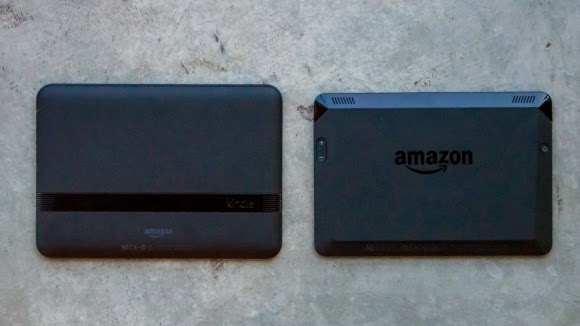
 It's still a bit dull looking, especially from the front. The rear is actually more attractive, with subtly shiny black plastic and tapered, sloping edges.
 When closed up, it lays flat across the display and the rear, shielding it from scuffs and scratches while adding little to the devices bulk. It converts to a stand by folding the flap back and pinching it together. It holds it at a perfect horizontal angle for movie watching, and keeps it upright in portrait mode as well, though with a slight lean.
The cover sticks to the rear with a magnet of impressive strength. You can hold it by the flap and give it a shake without causing a tumble. If you're buying an HDX, you really ought to consider some sort of cover, if not this one. No one likes a scratched tablet.
 With the Kindle Fire HDX, it's also built an excellent Android tablet, from a hardware perspective, at least. But while it's lightning fast and a great way to enjoy books, magazines, comics, music and movies, it comes up short in the places where the best tablets truly impress: third-party apps and a whiz bang customizable interface.
Amazon has all the media you crave, plus tube socks and cat food at rock bottom prices. It's built a great tablet, an Android one despite what its Fire UI wants you to think. But while it excels at getting out of the way so you can read, watch and buy, buy, buy, is it lagging behind the feature curve set by Google and Apple? Let's break it down.

Design

The 7-inch Kindle Fire HDX is no supermodel, but it is better looking than its predecessor, the brickish Kindle Fire HD.
 We don't often talk about accessories in a device review, but the origami case sold by Amazon deserves a shout out. It's quite expensive at £45 for plastic and £50 for leather, but it's a really elegant combination of protective cover and stand.
 Amazon opted to place the power button and the volume rocker on rear of the HDX. They're clicky and easy to press, but despite their sunken design, it's often hard to locate them. We frequently mixed up where they were, especially when holding the HDX in portrait orientation.
The requisite 3.5 mm headphone jack is found on the right side, and a microUSB is on the left. Both do their jobs while keeping cords from trailing over the display. There's also a front facing camera above the screen, but no camera on the back.
Overall, it's a functional, but less than eye catching design. It looks like something a power tool company would design, a construction worker's tablet, until you light up that screen. This is one of the places where Amazon's hardware stands toe to toe with the competition.
 It weighs just 10.7 ounces, so it's light enough to carry day to day without adding much weight to your bag. Its overall dimensions are 7.3 x 5 x .35 inches, making it easy to hold in one hand, but too large for a pocket.
The HDX has fine speakers as well. They're mounted on the back of the tablet, near the top, so it's easy to hold the tablet without covering them up.
We've heard louder sound on other tablets, but even at maximum volume, the HDX is free from the distortion that sometimes popped up on last year's model. It doesn't scream, but it's good enough to watch videos outside in a park without switching on the subtitles.

Hands on: Huawei Ascend G6 review

Hands on: Huawei Ascend G6 review

The Ascend G6 sits well in the hand, the volume and power/lock keys are easy to hit and the rear cover provides a decent level of grip while also being removable.

This gives you access to the SIM and microSD slots, but the battery is sealed in so you won't be able to swap it out.
Front on the Ascend G6 is a little bezel heavy, with a rounded bump protruding below the navigation touch keys beneath the display.
What else does the Ascend G6 provide? Well you get a 1.2GHz quad-core processor, 4.5-inch qHD display, 1GB of RAM, 8GB of internal storage, microSD slot and a sizeable 2000mAh battery.
The Ascend G6 comes running Android 4.3 Jelly Bean out of the box, which is acceptable considering its price tag and the fact Android 4.4 is the only set up it could possible make at this time.
Hauwei hasn't just left Android at its stock version though, feeling the need to slaver its Emotion UI 2.0 over the top - something which I haven't particularly enjoyed on previous handsets.
 To aid the first time smartphone audience further Huawei has also enabled a Simple UI, which removes all the widgets and myriad of small app icons for a large, tile based interface. It's rather reminiscent of the Windows Phone homescreen setup.
While this mode won't interest power users, it has clear advantages for certain segments of the smartphone market.
Unsurprisingly for a phone which is going to come in at under £200 the Huawei Ascend G6 sports an all plastic construction, although it is solid and the thick, faux-metal band which runs round the circumference keeps everything together nicely.
 It still looks relatively childish and that detracts from the overall user experience as the Ascend G6 looks and feels like a toy.
The Emotion UI removes the application list that we're used to on all other Android handsets, although this isn't necessarily a bad thing as it means all your apps are in one place - no confusion for first users when they see the same app on a homescreen and in the app list.
Huawei's all-in-one widget which combines features such a gallery, weather and contacts into one, dominating block is present on the Ascend G6, but I'd recommend you delete it as its functionality is limited.
  Last year Huawei launched its flagship Ascend P6 smartphone, and now atMWC 2014 the Chinese firm has added to the range with the Huawei Ascend G6.
As you may have guessed the G6 isn't a replacement to the P6, rather it's a more affordable option which shares the same design ethos as its bigger brother.
The key facts about the Ascend G6 are its price and connectivity. While Huawei was unable to give me a firm price, I was told that it will come in at under £200.
Not bad for a handset which is sporting the latest version of 4G technology - CAT 4 - giving you a super speedy internet connection.
 The 960 x 540 4.5-inch display isn't going to win any awards, but it's perfectly acceptable on the Ascend G6 and everything is easily visible.
Huawei has avoided filling the Ascend G6 with bloatware, which probably helps it maintain its fluid performance as you move around the handset.
It's not blazingly fast, but we didn't experience any lag during our brief time with the Ascend G6.
 Round the back of the Huawei Ascend G6 you'll find a 8MP camera with a single LED flash and the ability to record full HD video.
The camera app is passable, but features such as HDR are absent and the shutter speed isn't the fastest I've witnessed on handsets at this price range.
However from the handful of test shots I fired off the Ascend G6 appeared to perform well and it should be a decent little snapper.
That's just half the story though, as Huawei has also thrown in a 5MP front facing camera in an attempt to appeal to the growing selfie trend.
Coupled with the superfast 4G capabilities and quick access to social networks, Huawei is hoping the Ascend G6 will appeal to those dedicated to the likes of Facebook and Twitter.
The keyboard also stands up pretty well, allowing you to type a witty comment to go with your latest snap with reasonable next word prediction and spell checking.
The Huawei Ascend G6 release date is set for April in the UK, and you'll be able to pick it up in either black or white.
Early verdict

The Huawei Ascend G6 offers up a decent package of features and specs, but it's got tough competition with the cheaper Moto G and Nokia Lumia 520 offering better interfaces.

Thursday, 27 March 2014

Lawsuit Could Save Thousands of Sea Turtles (Op-Ed)

Lawsuit Could Save Thousands of Sea Turtles (Op-Ed)


 These nets pose a significant danger to the sea turtles, a vulnerable population. Sadly, all five sea-turtle species are considered threatened or endangered with extinction in the United States.
This is why, last month, Oceana and three other groups filed a notice of intent to sue the U.S. federal government, urging it to accurately analyze the impacts of shrimp trawls on sea turtles. In 2012, the U.S. National Marine Fisheries Service (NMFS) proposed a regulation that would require all trawl nets to use Turtle Excluder Devices (TEDs), which create an opening to allow turtles to escape once they have been captured. Unfortunately, NMFS withdrew the proposal after the fishing industry mounted fierce opposition, leaving the regulations to default back to the status quo.
This action meant bad news for sea turtles,since fishermen do not comply with existing rules to limit the amount of time the nets are towed through the water. Shorter tow-time requirements are designed so that any captured sea turtles can be safely released before they drown. But these rules are difficult to enforce, and studies have shown that a large percentage of fishermen do not comply with them.
 Better environmental analysis and stricter enforcement by NMFS could easily save thousands of sea turtles every year. The U.S. government is currently failing in its duty to ensure that federally authorized activities (including fishing) do not jeopardize the continued existence of endangered and threatened species, as required by law under the Endangered Species Act. Sea turtles are vital for healthy marine and coastal ecosystems, helping to maintain productive coral reef ecosystems and transporting essential nutrients from the ocean to beaches and coastal dunes.

 Turtle nesting in Florida will continue into October, possibly stretching further into the fall. To ensure that these animals safely reach their nesting beaches, NMFS must assess the harmful impacts of shrimp trawls, set limits on the number of sea turtles injured and killed, and require steps to ensure that those limits are not exceeded. Those measures could include mandating TEDs or instituting closed areas when sea turtles are present. Without accurate and unbiased analysis of the effects of these and other fishing activities, the recovery and continued existence of these majestic marine animals will be at risk into the future.


 On March 1, the sea-turtle nesting season officially began in Florida, with the wondrous appearance of leatherback sea turtles returning to lay their eggs. Later this spring, loggerhead and green sea-turtles will follow suit, flocking to Florida's beaches in large numbers. The state is an important destination for these marine reptiles; of the seven different sea-turtle species in the world, five call these warm waters home at some point during their migrations. In fact, Florida's beaches host more nesting turtles than any other state.
Driven by an incredible instinct to return to the same beaches where they themselves were born, these turtles might not know that they are swimming into waters used by shrimp trawlers, one of sea turtles' most dangerous and deadly obstacles. Shrimp trawlers in the Gulf of Mexico and the U.S. southeast Atlantic kill or injure an estimated 53,000 sea turtles — every year — as the ships tow huge nets the width of football fields slowly through the water, trapping almost everything in their wake.


Beautiful Flower Wallpaper

Beautiful Flower Wallpaper

Spring is the perfect time to rejoice and enjoy the beauty of nature; it is the time when beautiful flowers blossom and beautify the whole world around them with their delicate feel. The beautiful season of spring is about to come, so we decided to spark your inspiration with a showcase of flower photos. We hope that you will fall in love with these beautiful photos.